


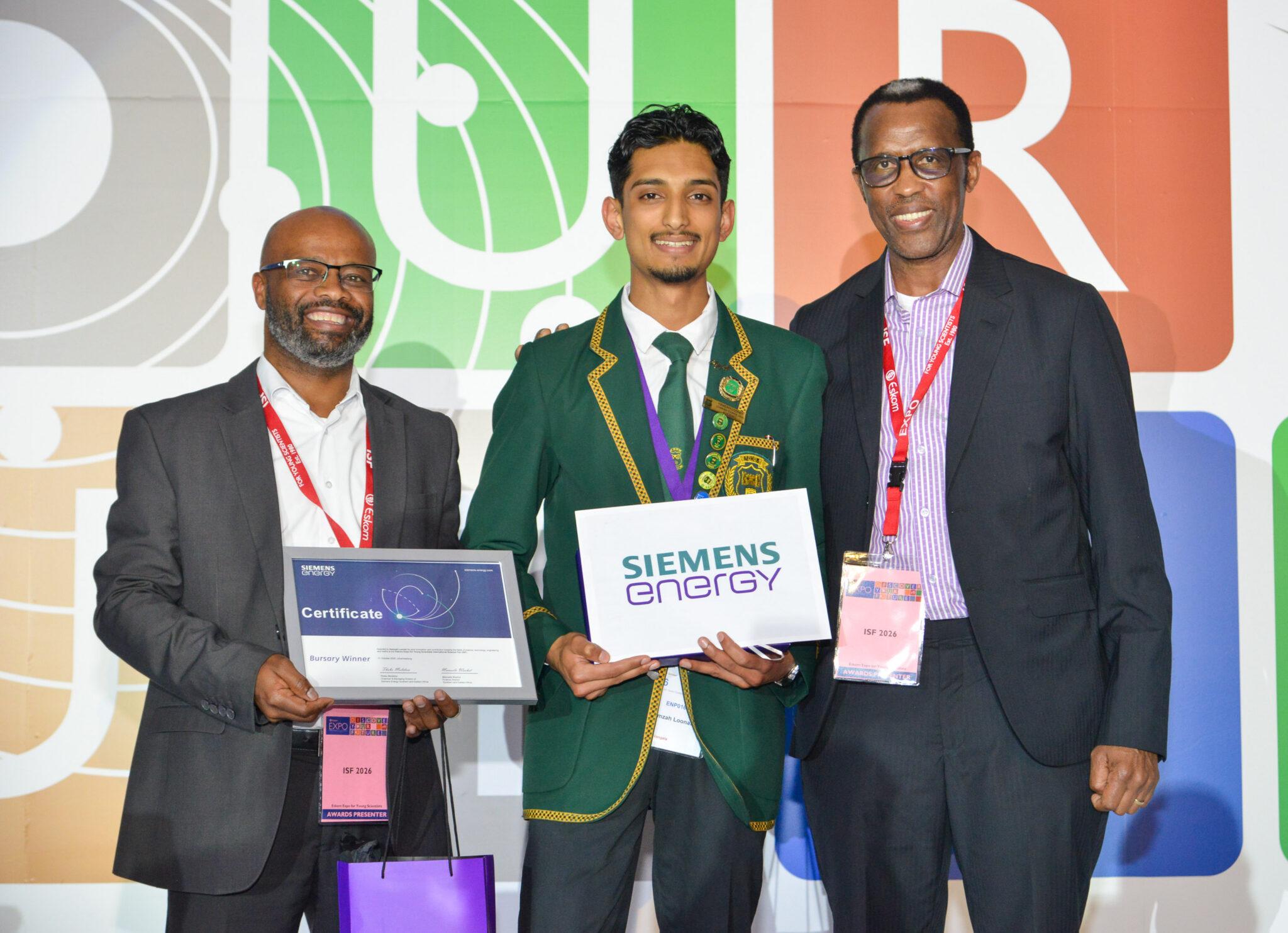
For Grade 12 learner Hamzah Loonat, the goal behind his 2026 Eskom Expo journey was clear: develop an idea that could solve a real-world problem and work towards securing an opportunity to pursue his engineering ambitions after Matric.
That goal became a reality at the 46th Eskom Expo International Science Fair (ISF), where the Middelburg Hoërskool learner received a Siemens Energy Higher Education Bursary valued at R675 000, one of several honours he earned at the fair.
Loonat, who represented the Nkangala Region, also received a Bronze medal and the PERT Industries Award, which included an Elenco Snap Circuits SC-300R and a “Snapino Making Coding a Snap” kit valued at R5 000.
The Siemens Energy bursary will enable him to study towards a Bachelor of Science in Engineering at a South African university of his choice, covering tuition fees, textbooks, accommodation, meal allowances and a laptop.
For Loonat, hearing his name announced as a bursary recipient was the defining moment of his ISF experience. “I could not believe it when I won the Siemens Energy bursary. It felt unreal,” he said. “Ever since I started my 2026 Expo project, the goal was to get a bursary, as I am heading to university next year.”
The achievement represented the culmination of months of balancing research with the demands of his final year at school. “As they called out my name, it hit me that all the hard work, all the dedication, all the sleepless nights between June examinations and finals, and all the school-related activities were worth it. It all paid off,” Loonat said.
For him, however, one aspect of the achievement mattered even more.
“I knew at that moment I made my parents proud, and that’s one of my primary goals in life,” he said. “It made me realise that participating in Eskom Expo is really worth it.”
Loonat describes himself as someone who has always been curious about how things work, particularly in technology and engineering. Rather than simply thinking about possible solutions, he enjoys transforming ideas into something tangible.
“I enjoy taking an idea and turning it into something physical that people can actually see and use,” he said.
That mindset also drew him to Eskom Expo. Growing up, Loonat often found himself thinking about problems and possible solutions, but the programme gave him a structured opportunity to test those ideas.
“Eskom Expo gave me that platform to identify a problem, do research on that problem, develop and practically test a solution, and present it to people who actually recognise the work and are interested in it,” he said. “Eskom Expo allowed me to bring those ideas to life and prove whether they could actually solve a real-life problem.”
While the awards were significant, Loonat said some of his strongest memories from the ISF came from the people he met during the week.
“My standout experience at ISF is the amount of new friends I made, nationally and internationally,” he said. “It was a week with complete strangers all together with similar mindsets. That allowed us to bond, and we all became one big family.”
One moment in particular stood out after the Special Awards Ceremony. “Everyone congratulated everyone. Even though some did not win, together we all felt like winners,” he said.
His interest in STEMI is closely connected to his personality and desire to approach challenges differently.
“I’ve always loved thinking outside the box and finding easier ways to do things,” Loonat said. “I am very curious and thrive on solving problems.”
That practical curiosity extends well beyond his science fair research. Loonat has a strong interest in cars and automotive engineering, particularly BMWs, and enjoys learning about vehicles and working on his own car project.
He also enjoys travelling and spending time with family and friends, but perhaps his most distinctive hobby is teaching himself practical skills.
Whether it is carpentry, plumbing, tiling, electrical work or welding, Loonat enjoys learning how to do things for himself and testing his abilities in unfamiliar areas.
“I enjoy challenging myself to new limits,” he said.
With his Eskom Expo journey now resulting in a major higher education opportunity, Loonat encourages future participants to start with a problem that genuinely matters to them rather than trying to develop something simply because it sounds impressive.
“If you’re passionate about the problem, you’ll be much more motivated when things don’t work the first time,” he said. “It’s your idea, so you can explain it and understand it the best.”
He also cautions aspiring young scientists that developing a successful research project involves setbacks and failures. “Instead of giving up, use those setbacks to motivate you to find the solution,” he said.
For participants who do not receive the result they hoped for on their first attempt, his advice is to listen carefully to feedback from judges, improve the research and return stronger. “Their expertise and your idea will allow you to make it to ISF and achieve,” he said.
Above all, Loonat believes young scientists should never dismiss an idea simply because it initially appears small. “A project doesn’t have to start as something revolutionary. Start with a problem, ask questions, research properly, build, test, improve and keep going,” he said.
“You never know where that first idea can take you.”

 CreativeBox
