


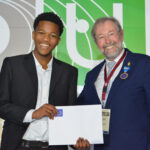


Balancing Matric with the demands of an Eskom Expo research project was not always easy for Lihlelethu Shabalala, but her determination paid off when she earned a Silver medal and a provisional Eskom Merit Bursary at the 46th Eskom Expo International Science Fair (ISF).
Shabalala is a Grade 12 learner at Hoërskool Generaal Hertzog in eMalahleni, Mpumalanga, and represented the Nkangala Region. The Eskom Merit Bursary recognises academic performance, innovation and achievement and is subject to confirmation of her final National Senior Certificate results and compliance with Eskom’s bursary and admission requirements.
Hearing her name announced as a bursary recipient was a moment she still finds difficult to believe. “Me winning the bursary was such a surreal moment for me. I still can’t believe it. Sometimes I Google my name to actually see if I really won it,” Shabalala said.
“When I heard my name being called, I was shaking throughout my whole body, my fingers were numb, and my heart was beating so fast.”
Once the initial shock subsided, the achievement gave Shabalala a chance to reflect on what it took to reach ISF while completing her final year of school.
“I was so proud of myself. I never would have thought I could have been capable of doing what I did,” she said. “Being in Matric and having to balance the Expo with school felt overwhelming, and there were moments when I wanted to give up, but I kept pushing. It felt good to see my hard work pay off and experience this win.”
Shabalala first heard about Eskom Expo in Grade 10 when a representative visited her school. She was immediately interested in the opportunity it offered young people to explore innovation, problem-solving and critical thinking. She admits the chance to win prizes added to the appeal.
At ISF, however, she found that the experience extended far beyond the competition and awards.
“One of my most memorable experiences was the environment, the opportunity to meet and talk to people from different provinces across South Africa and countries outside of South Africa,” she said.
The variety of projects presented by other young scientists also inspired her, and the speakers at ISF left a lasting impression. “The speakers at the Expo were so encouraging and motivational. You could really hear the belief and admiration they had for us as the future of the country,” Shabalala said.
Her own passion for science, technology, engineering, mathematics and innovation (STEMI) has its roots in a curiosity that began during childhood.
“Growing up, my mom would complain that I was always asking questions, and because most of my questions were left unanswered, I naturally sought to answer them,” she said.
That curiosity developed into an enjoyment of Life Sciences and Mathematics and is closely connected to her ambition to become a doctor. Shabalala’s interest in medicine was influenced by the community where her mother grew up and the limited access to healthcare she observed there.
Her fascination with the human body and Life Sciences strengthened that ambition, while job shadowing at her local hospital further developed her interest, motivation and passion for medicine.
Shabalala describes herself as curious, family-centred and somewhat introverted until people get to know her. She lives with her mother and sister and enjoys helping others. Away from STEMI, she enjoys reading, particularly mystery and thriller books, as well as baking with her family.
Her message to potential Eskom Expo participants is not to assume that the programme is reserved for learners who fit a particular academic stereotype.
“Don’t believe the stereotype of having to be a smart academic achiever to be able to enter the Expo,” Shabalala said. “The Expo is a place that gives learners an opportunity to express their ideas and showcase their problem-solving skills.”
She encourages learners not to question whether they are good enough or whether they belong in a science fair environment. “The only criterion for Expo is wanting to investigate, create and build something that interests you, a problem that you want to solve,” she said.
Most importantly, Shabalala believes participants should appreciate what they have accomplished simply by challenging themselves. “Enjoy the experience, the people and the environment, and appreciate yourself. Give yourself credit for doing something outside of your comfort zone.”

 CreativeBox
