


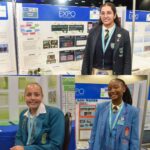

Nine exceptional young scientists from across South Africa were recognised at the 45th Eskom Expo International Science Fair (ISF) for their innovation and excellence in research, earning their schools laptops sponsored by Siemens Energy.
Each learner represented their rural school’s Science Club with distinction, contributing to the growth of science, technology, engineering, and mathematics (STEM) education in their communities.
The Eskom Expo ISF, held at Emperors Palace in Kempton Park recently, brought together South Africa’s brightest young scientists to showcase their research projects before judges, sponsors, and industry experts. The event celebrated youth innovation and highlighted the importance of science and technology in solving real-world challenges.
Through its awards, Siemens Energy continues to encourage a passion for STEM learning in under-resourced areas by equipping schools with essential tools to enhance science education. This year, nine rural schools, one from each province, received laptops, while the individual learners who presented the winning projects on their schools’ behalf were awarded tablet computers.
The provincial winners included:
- Eastern Cape: Petronellah Kazembe from Masiphathisane Senior Secondary School
Research project: Investigating Spekboom’s Carbon Sequestration Potential through Biomass Analysis and pH Testing
Kazembe’s environmental study found that loam soil and outdoor sunlight offered the best conditions for Spekboom growth and carbon absorption. - Free State: Zanele Witbooi from R.T. Mokgopa Senior Secondary School
Research project: Glow in the Dark Highway Paint
Witbooi’s innovative idea explored glow-in-the-dark paint as an alternative for road markings to improve night-time visibility. She found strontium aluminate to be more effective than zinc sulphide, though at a higher cost. - Gauteng: Lethiwe Zulu from Thuto Lefa High School
Research project: HYDRO TERRA X
Lethiwe’s project combined a micro hydro turbine, solar panel, and MPPT controller to develop a hybrid renewable energy prototype. Her research highlighted youth-driven environmental innovation and civic responsibility. - KwaZulu-Natal: Anele Gumede from Hhoye Secondary School
Research project: A Multi Power Supply Box
Gumede designed a multi-source electricity generation system using recycled materials, offering a sustainable energy solution for off-grid communities. - Limpopo: Clinton Mabulana from Relebogile High School
Research project: The Sentimotion Law
Mabulana developed a mathematical model linking emotional states to walking speed, achieving 96% accuracy in predicting happiness levels, with potential applications in healthcare, sports, and engineering. - Mpumalanga: Phumelele Lukhele and Nondumiso Nhlabathi from Ubuhlebuzile Research project: A Chimney That Cleans Smoke Using Dry and Wet Scrubbers
The duo designed a chimney system that filters smoke through dry and wet scrubbers to reduce air pollution. - Northern Cape: Leony Moyisile from Thabane High School
Research project: A Doppler’s Driven Diagnosis to Detect Breast Cancer and Uterine Abnormalities
Moyisile’s physics project explored how the Doppler Effect could be applied to detect abnormal tissue masses. Her work simulated medical Doppler ultrasound using balloons filled with various materials, finding that denser materials like copper crystals produced distinct sound wave changes. - North West: Nolwazi Ringane from Mmankala Technical High School
Research project: Flood Detection System
Ringane created an early-warning system for rising water levels, featuring a water-level sensor and alarm system designed to protect homes from flooding. - Western Cape: Linathi Koyana from Murray High School
Research project: Low-Cost Water Purifier: A Homemade Solution for Rural Communities
Koyana developed an affordable water purification system to reduce turbidity, odour, acidity, and bacterial contamination; an innovation aimed at improving access to safe drinking water in rural areas.
Siemens Energy’s investment aligns with Eskom Expo’s Science Club initiative, which encourages learners to explore STEM fields throughout the year. Science clubs provide hands-on experiences, mentorship, and collaboration opportunities that prepare learners for participation in regional, national, and international science fairs.
Schools or teachers interested in starting their own science clubs can download the Science Club Guidebook available here. The guide outlines how to structure meetings, conduct experiments, and prepare learners for research-based projects.

 CreativeBox
